Thai language and custom slides

Winkletter • 14 Jun 2026 •
TL;DR: I made some skills for learning Thai language, and an application for custom slide decks based on Markdown and “rhetorical shape”.
Inspired by @jasonleow’s trip to Chiang Mai, I decided to make some Claude Skills for doing Thai-language cultural and linguistic research.
- Thai language research skills: A Google Doc with three skills for researching Thai language and culture along with an example report on traffic or การจราจร (kan jara-jon).
I find these reports fascinating. They’re not too heavily weighted on grammar or syntax, and instead use language as a way to explore culture and vice versa. I think I might make skills for more languages and locales. I’ll have to consider how to adapt it to French or Spanish where there could be different locales with unique cultures and varieties of spoken French or Spanish.
Custom slide deck
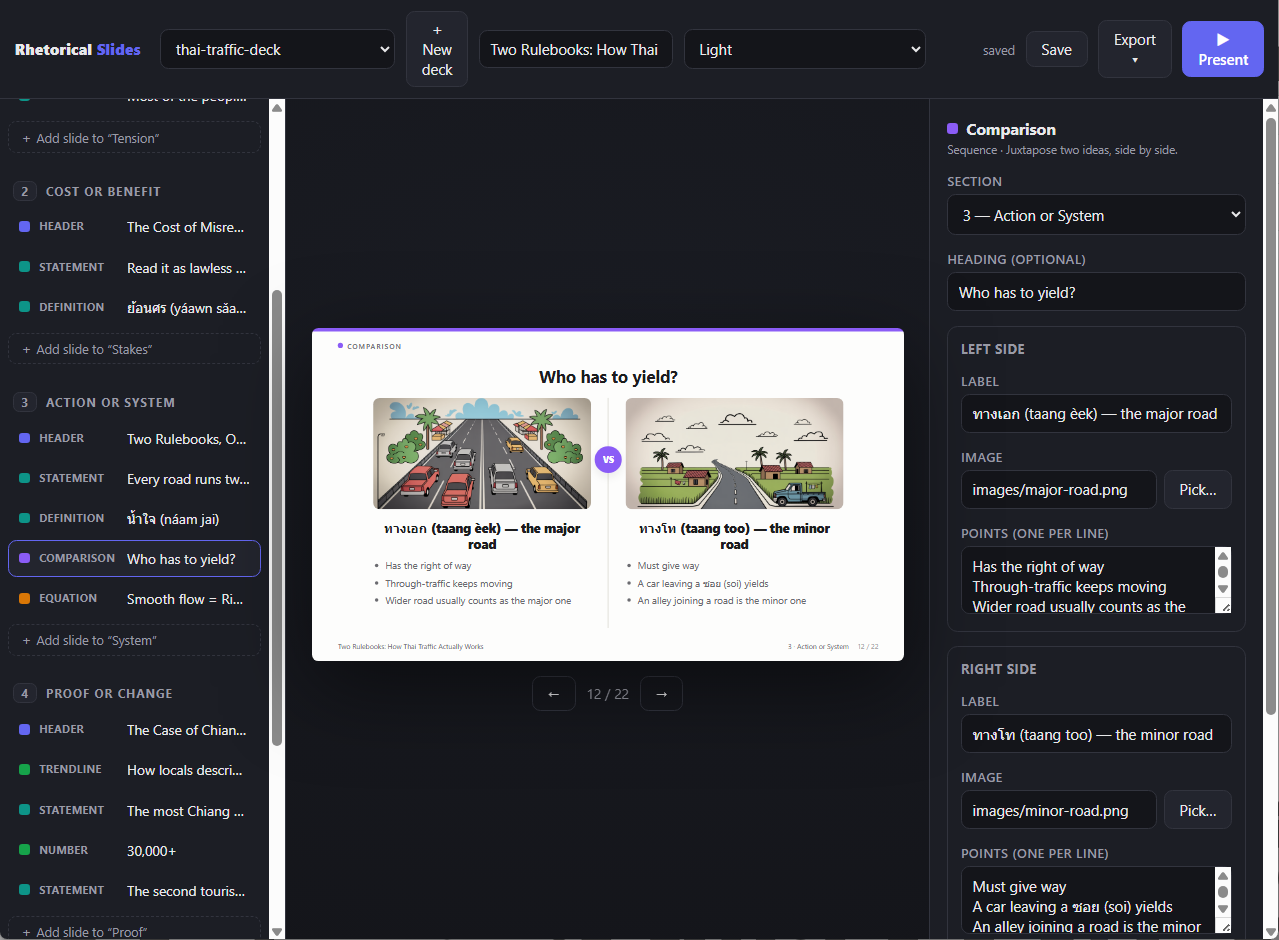
I also finished up a local web application called Rhetorical Slides. How do I explain this project?
It’s a bespoke slide deck editor and presenter that uses my rhetorical shape framework. This forces each slide into one of 20 formats: header, comparison, trendline, etc. The slide decks are saved as markdown files, which get interpreted based on the slide types. Because the slides are structured, I can choose how to display each type of slide.
Because it uses Markdown, I can also use AI to generate the slide deck as a single file. I have a skill for that. I add a few images and this makes a full presentation I can use as the basis for an article or a video. At least, that’s the long-term goal.
Example slide
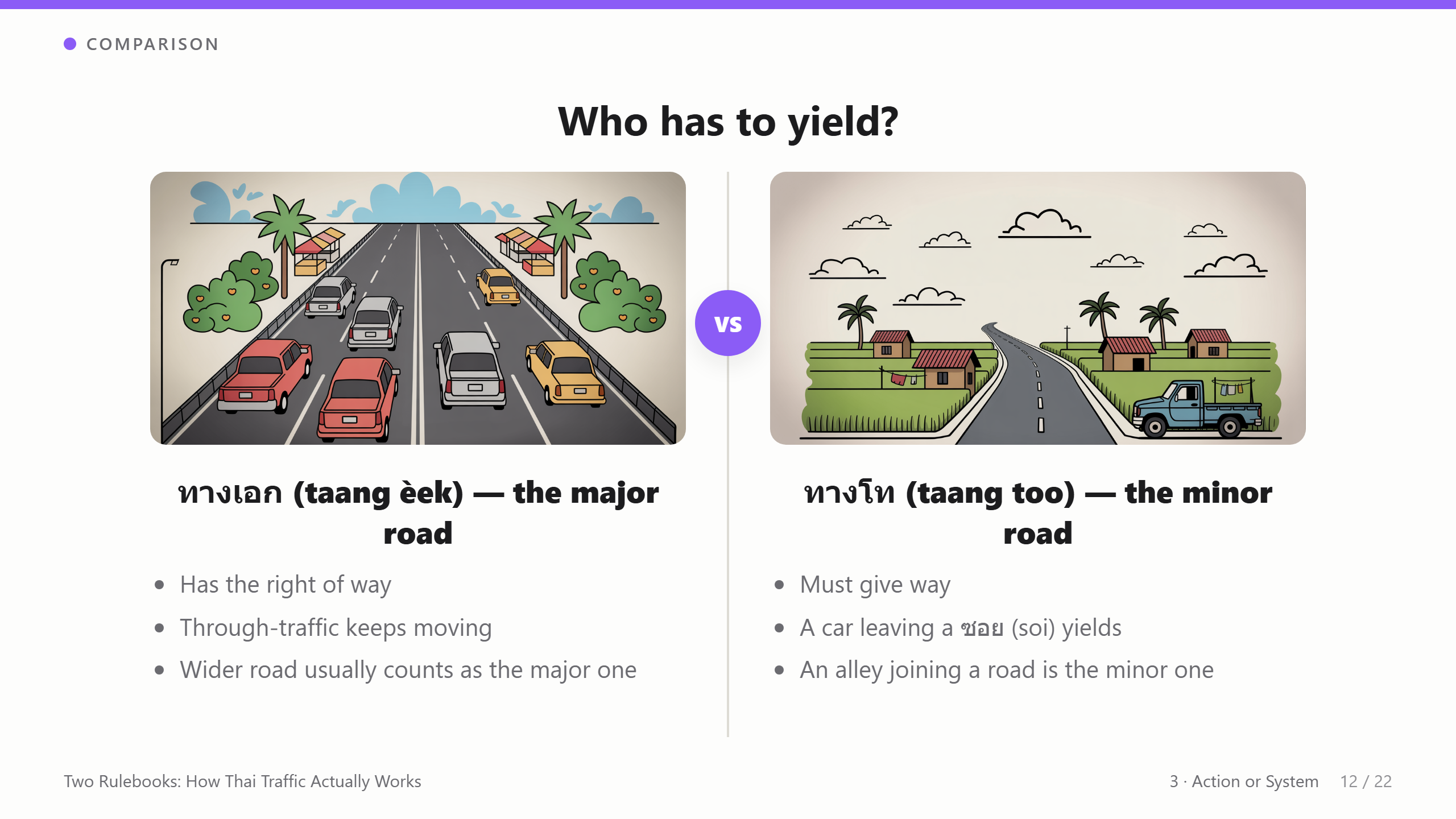
Here’s the Markdown and YAML for the slide above.
type: comparison
section: 3
title: Who has to yield?
left:
  label: ทางเอก (taang èek) — the major road
  points:
    - Has the right of way
    - Through-traffic keeps moving
    - Wider road usually counts as the major one
  image: images/major-road.png
right:
  label: ทางโท (taang too) — the minor road
  points:
    - Must give way
    - A car leaving a ซอย (soi) yields
    - An alley joining a road is the minor one
  image: images/minor-road.png
notes: |
  The concrete legal backbone. Under the Road Traffic Act, traffic on the ทางโท (taang too)
  gives way to traffic on the ทางเอก (taang èek), and a road that a ตรอก (dtròk, alley) or ซอย
  (soi, side-lane) joins onto counts as the major road — so the car nosing out of the soi is
  the one that must wait. This is the rule tourists most often miss, because in practice it's
  softened by น้ำใจ (náam jai): the through-driver often waves the soi car out anyway.
The AI put together the text based on a custom set of instructions and the report on Thai traffic, while the images were generated and added manually by me. The layout of the slide is purely determined by the system’s presets. The slide text and links to image assets are all editable in the system, and I can export the results as individual slides or a PDF.
I’ll definitely be building more and more functionality to this over time.
- Thai-traffic A full 22-page PDF of the slides in my Thai traffic example.