Function > categories

Winkletter • 15 Sept 2026 •
I’m reading a difficult book called S/Z by Roland Barthes. It makes my head hurt. Just the title alone takes a few paragraphs to explain. But I’m sensing a lot of synergy with the author’s views (as best as I can understand them). It was written at a time when narrative studies focused on the structure of a story. Researchers were trying to construct patterns that could describe every story, something we see today in frameworks with colorful names like Save the Cat, Romancing the Beat, and Dan Harmon’s Story Circle.
For Barthes, these attempts overlook the difference of each text and how it functions. Categories rob a story of its difference. I was surprised how this fits with a project I’ve been working on to gather examples of words, lines, and passages. I’m studying how these examples function in a text as an individual unit of discourse in a setting.
- How does the word “siddled” imply a character’s mental state?
- What does it tell us about a character that they use complex literary terms to elevate their plain, everyday activities?
I sometimes look for these insights on my own – they’re literally everywhere. But I’m now supercharging the process with AI.
Here’s an exploration of two lines from Anne of Green Gables.
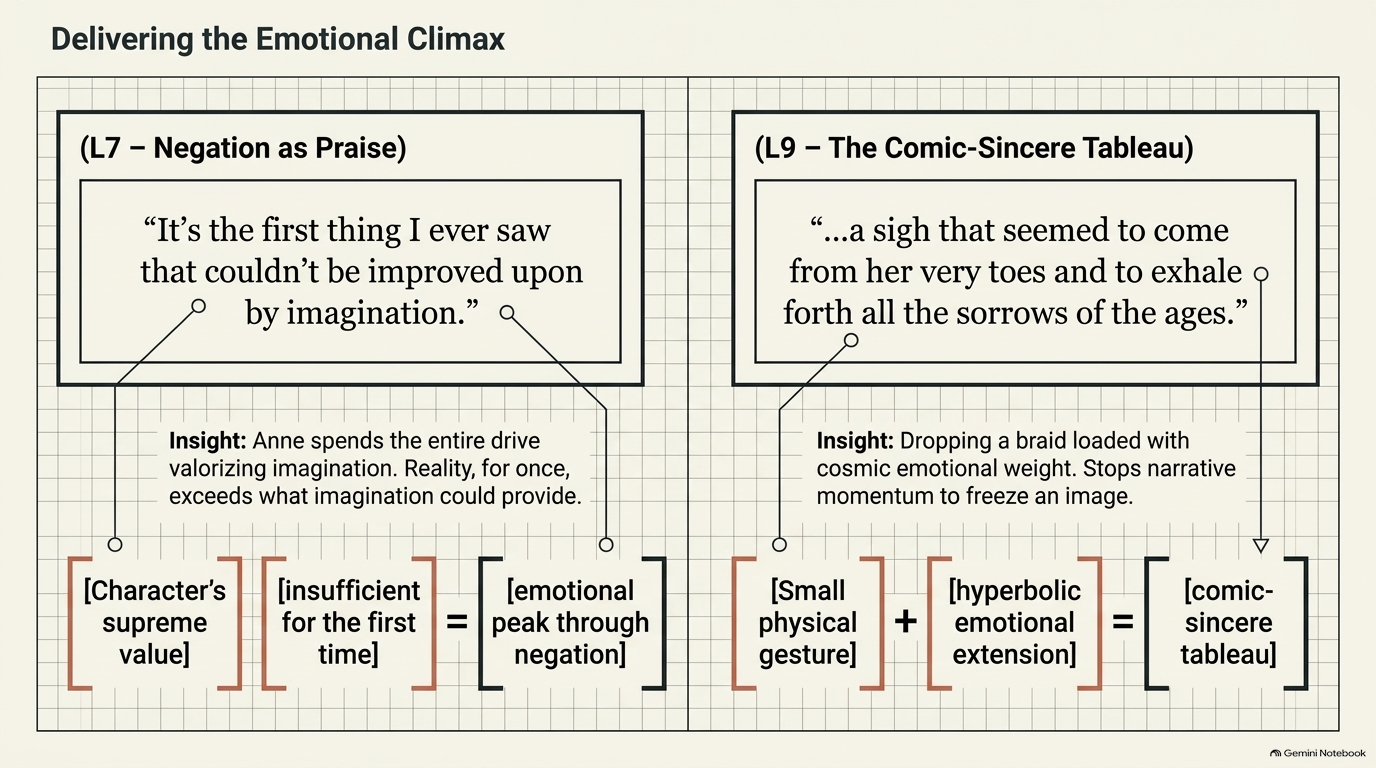
Most of the writer’s work of choosing a word and laying out a line is being done intuitively. So much of the work is happening below the surface. So it’s surprising how interesting a line can be when it is closely observed.
I’ve even turned these analyses on my own writing, and I love seeing how my writing functions and which moves I made without being 100% aware of what I’m doing on a conscious level.
EXAMPLE FROM LIFELOG: “Recipes versus ingredients” (Jan 7, 2025)
| Field | Content |
| The Selection | “I watch a cooking show on YouTube where professional chefs cook alongside normal home cooks. … The home cooks tend to start with recipes and make substitutions based on what’s available. The chefs, on the other hand, start with ingredients … ¶ The home cook says, ‘I’m making {recipe}, but I’m substituting {ingredient} for {ingredient}.’ The chef says, ‘I’m pan frying {ingredient} and adding a bit of {ingredient} and making a kind of {recipe}.’ ¶ This shows a fundamental difference between creator and a consumer. … ¶ A writer works with ingredients. A reader consumes the finished dish.” |
| Arc | → Concrete observation (cooking show) → Template notation (invented syntax) → Generalization via analogy → Compressed aphoristic landing |
| The Work | The passage demonstrates a characteristic arc of this writer’s best entries: begin with a specific, concrete source (a YouTube cooking show), extract a structural pattern from it, generalize the pattern, and land it as an aphorism. What makes this instance distinctive is the template-notation move in paragraph two — the curly-bracket syntax is an invention that allows the reader to see the structural difference between two processes without being told about it. The passage teaches through form. The final couplet is telegraphic because the preceding paragraphs have done all the building; the reader arrives at the aphorism already understanding it. |
| Engine | The inversion of the variables. The reader sees {recipe} and {ingredient} in position A, then sees them swapped in position B, and the structural difference between creation and consumption becomes instantly visible. The notation is the engine. |
| Stencil | [Concrete observation from media/daily life] → [Structural pattern extracted using invented notation or parallel syntax] → [Generalization from specific domain to universal principle] → [Compressed aphoristic couplet as landing]. |